
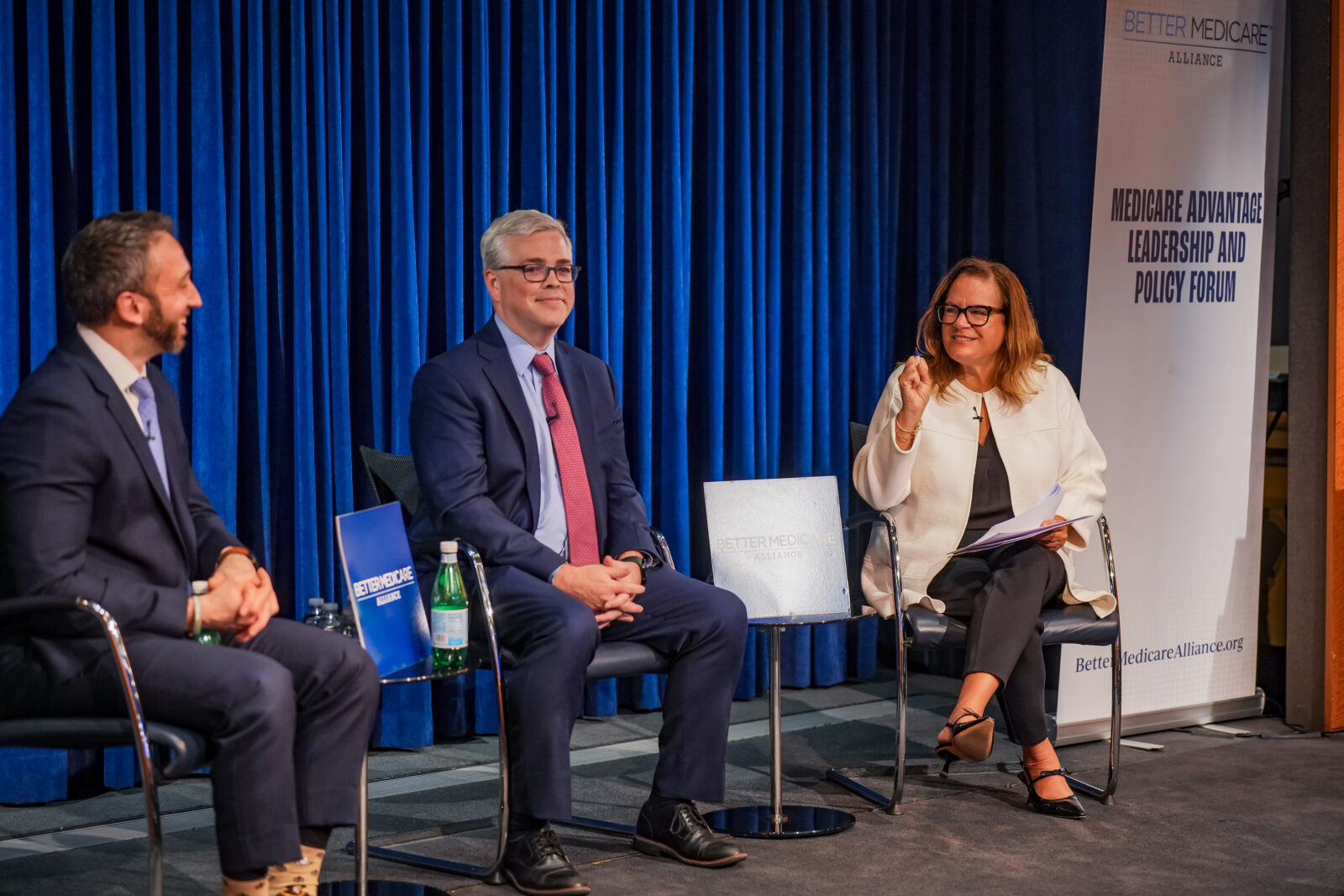
Strengthening Medicare Advantage: Takeaways from BMA’s 2026 Leadership and Policy Forum
With open enrollment approaching, about 150 policymakers, healthcare leaders, allies, beneficiaries, and researchers gathered in Washington, D.C., on Sept. 22 for Better Medicare Alliance’s 2026 Medicare Advantage Leadership and Policy Forum. The conversations focused on how to strengthen the program while protecting the affordability, care, and benefits that more than 35 million beneficiaries value.
CMS recognized Medicare Advantage’s value and the need for stability. In a video welcome, CMS Administrator Mehmet Oz called strengthening Medicare Advantage one of the agency’s top priorities. “CMS is committed to making Medicare Advantage an excellent option for beneficiaries this open enrollment period and long beyond,” he said.
John Brooks, CMS deputy administrator and director of the Center for Medicare, also recognized the value Medicare Advantage delivers through supplemental benefits, coordinated care, and quality. In a conversation with BMA President and CEO Mary Beth Donahue, both Brooks and Alec Aramanda, principal deputy director of the Center for Medicare, emphasized stability as CMS considers changes, and they invited stakeholders to flag policies that could have unintended consequences for beneficiaries. “When we express our commitment to the stability of Medicare Advantage going forward … it’s because of that tremendous value that the plans are delivering,” Brooks said.
Allies and providers underscored stability as well. Susan Dentzer of America’s Physician Groups emphasized how vital stability is to Medicare Advantage’s continued success. “The one part of the system you really don’t want to destabilize right now is the part of the system where you’re taking care of the oldest, sickest people in the country. Because they need a stable system,” she said. Wyatt Decker, MD, of UnitedHealth Group, echoed that point. “Whether you’re a provider or payer, the program needs stability,” he said. Shawn Martin of the American Academy of Family Physicians called for greater investment in primary care and less friction between physicians and patients.
Supplemental benefits are delivering measurable results. During a panel moderated by Vicki Shepard of the Healthy Aging Coalition, Maya Rams Murthy of Food Health Collective described pairing medically tailored food with culturally responsive guidance from registered dietitians. Rhonda Quintana of Ceresti Health described a dementia care program her organization has offered as a supplemental benefit to Medicare Advantage. The program supports members living with dementia by training their family caregivers to spot early changes in condition, often one to three days before a crisis. Across three Medicare populations, the approach has reduced hospitalizations by more than 60%, and some plans and provider groups have built it directly into their care management.
Two members of BMA’s Beneficiary Advisory Council, Rob Rasmussen of Wisconsin and Steven Hadfield of North Carolina, met with their home state members of Congress before the forum and stayed to present this year’s Medicare Advantage champion awards to Rep. Steven Horsford (D-Nev.) and Rep. Aaron Bean (R-Fla.). Horsford was recognized for his work on prior authorization and supplemental benefits on the Ways and Means Committee. Bean was recognized for leading the Apples to Apples Comparison Act, which would require more consistent data comparisons between Medicare Advantage and traditional Medicare.
MedPAC’s own analysis shows Medicare Advantage’s efficiency. MedPAC Chair Amol Navathe said Medicare Advantage medical expenditures are 18% below those of comparable traditional Medicare beneficiaries. Even after administrative costs and margin, he said, Medicare Advantage bids are 5% below comparable traditional Medicare spending. He acknowledged BMA’s critique of MedPAC’s methodology and said stakeholders won’t agree on every point, which is why serious dialogue matters. He also explained what MedPAC’s payment estimates do and do not show and welcomed substantive discussions about its methods.
“The policy question is actually not simply can Medicare Advantage deliver care efficiently,” Navathe said, “because I think we can definitively say that evidence suggests that it can.” The question, he continued, is how to preserve those efficiencies and maximize value for beneficiaries and taxpayers.
That question will help guide BMA’s next steps. At the forum, Donahue previewed a 10-point policy roadmap, developed with input from allies, that BMA will release in the coming weeks. It will offer Congress and CMS practical ways to improve the beneficiary experience while protecting affordability, choice, and stability.